“Helensburgh’s got talent!” Poster
Please share our poster – or print it at home from the PDF – click here to download
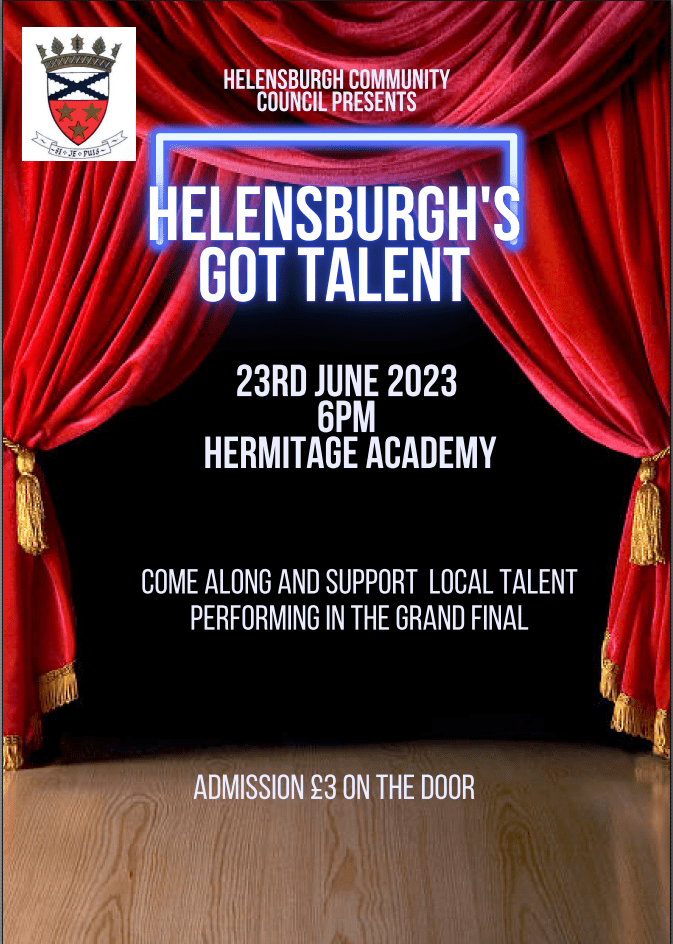
Please share our poster – or print it at home from the PDF – click here to download
HERMITAGE ACADEMY
Friday 23 June 2023
Helensburgh enjoys such a rich vein of performance talent : amateur musicians, dancers and other artists. To showcase their skills and acts, Helensburgh Community Council (HCC), under its ‘Music in the Square’ initiative, is organising a Competition
‘Helensburgh’s Got Talent’
HERMITAGE ACADEMY – FRIDAY 23 JUNE
The Competition will be judged by a distinguished panel of local independent assessors. They will award a Prize to the top 3 entries. All other performers will receive a certificate of recognition for taking part.
To enter the Competition HCC is inviting interested parties to submit demos, videos using the QR code below, which will be loaded onto Google Drive, or by visiting: HTTPS://TINYURL.COM/BDFZD64A.
Submissions from entrants should be made no later than 5th June.
Based on the submissions, candidates will be invited to perform them on Stage before a live audience at the Academy from 18.00 onwards.
The Competition is open for the public to enjoy for a £3 entrance payable on the day. Doors are open from 17.30. Refreshments will be available.
The event is overseen by two members of the Helensburgh Community Council- Tariq Durrani and Nigel Millar, who may be contacted for further information via e-mail ( tsdurrani@gmail.com , or millarnc@btinternet.com).
HCC wishes to thank Hermitage Academy for making available its superb premises for us all to enjoy :
“Helensburgh’s Got Talent”


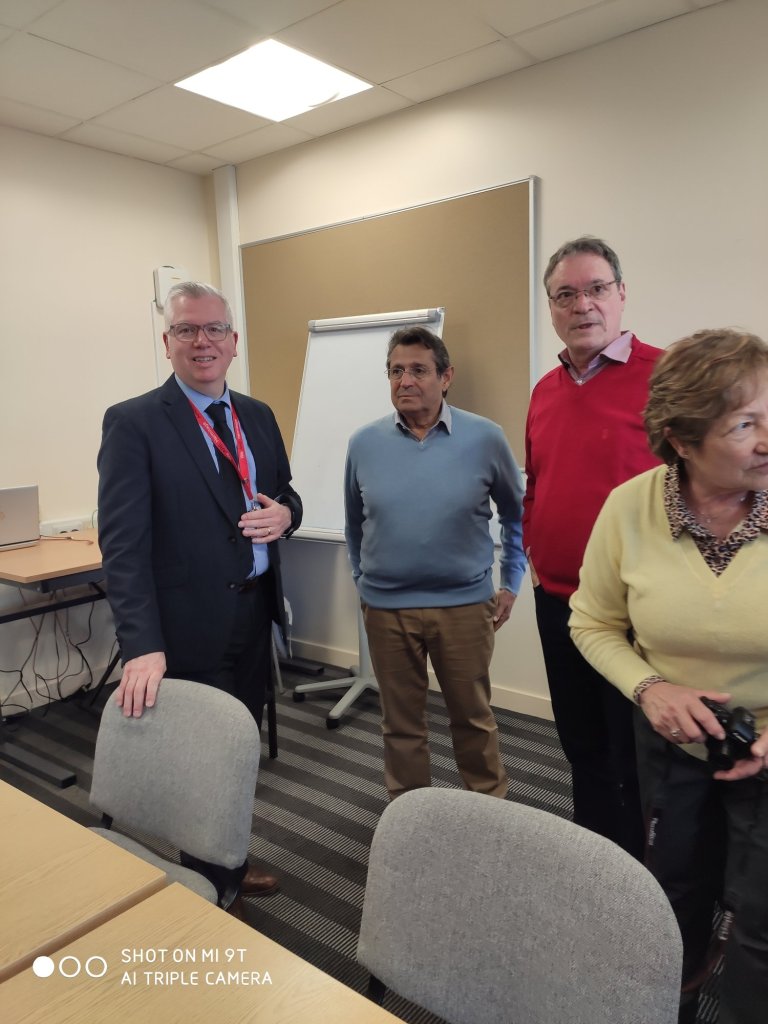
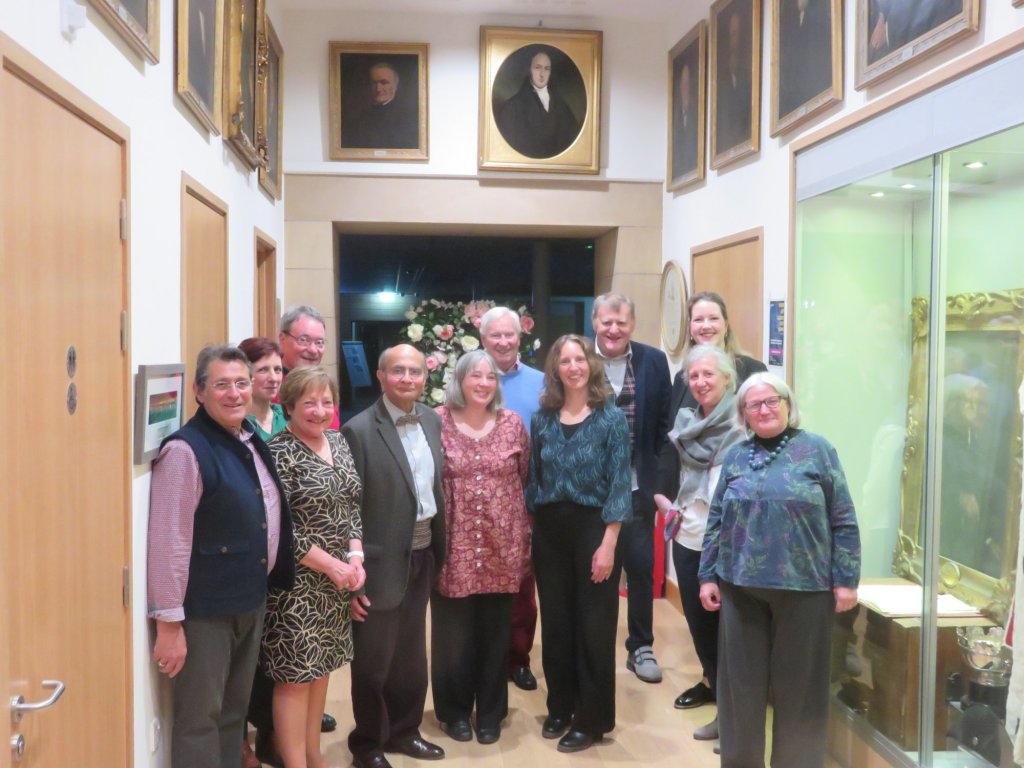
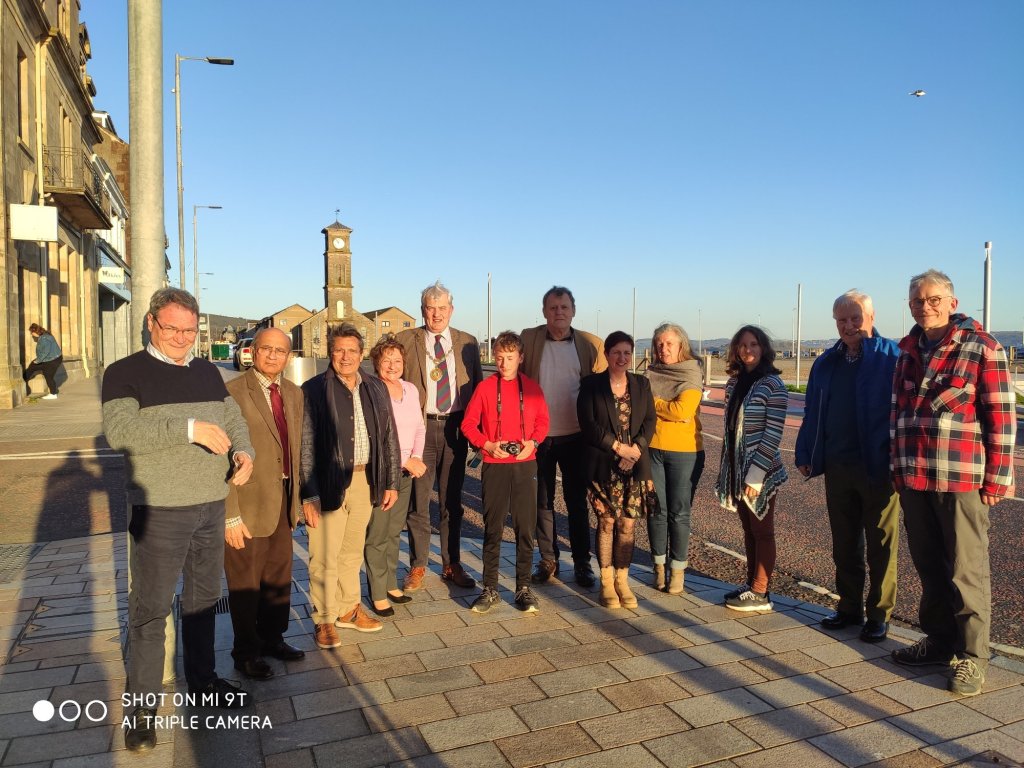
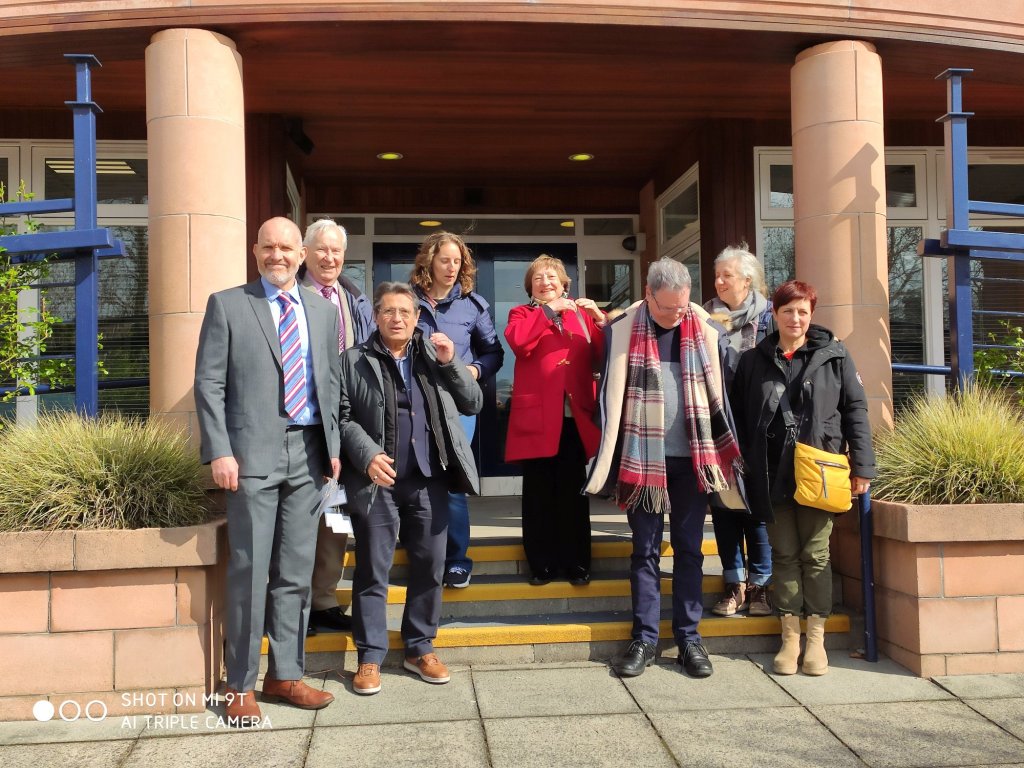
A delegation of seven from Le Taillan-Medoc (pop 10,000) , in the heart of France’s Bordeaux classic red wine growing region visited Helensburgh from 15 -22April 2023 staying at the Riva Boutique Hotel on West Clyde Street. Very comfortable and its Scottish Breakfast was rated as Formidable.
Since 2020 Helensburgh Community Council (HCC) has been in discussion with Mayor’s office in Le Taillan on building a strong relationship between our two towns with its genesis given below, under “ Ties with Le Taillan, Bordeaux” France. The visit of the delegation was most timely. As well as showcasing all Helensburgh has to offer we were able to explore opportunities for exchanges of young people, sports teams, language initiatives, business ties, joint projects and more. The recent opening of direct Easyjet flights between Glasgow and Bordeaux, from July to September, 2023 (advance fares from £39 one way) is an added bonus.
This is how the visit unfolded:
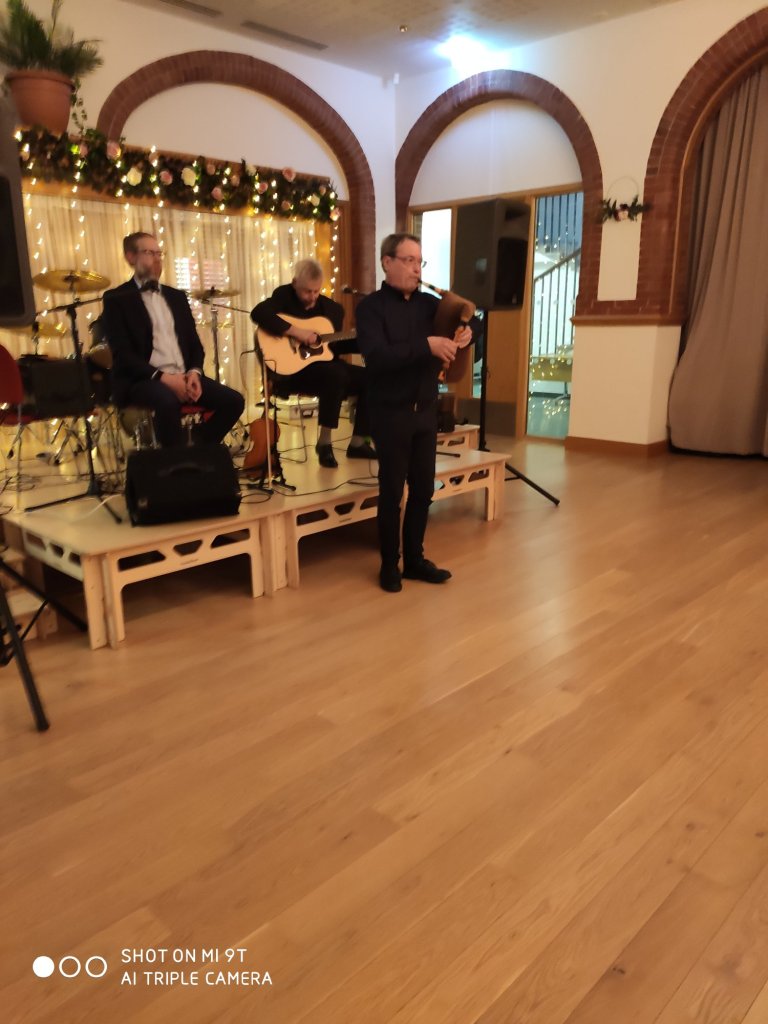
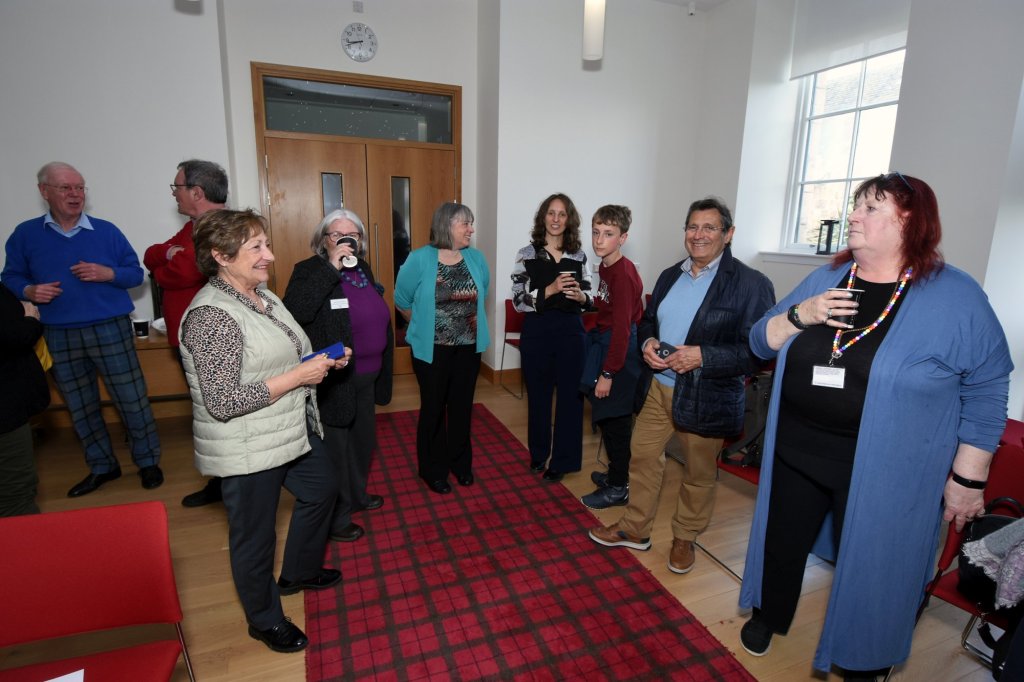
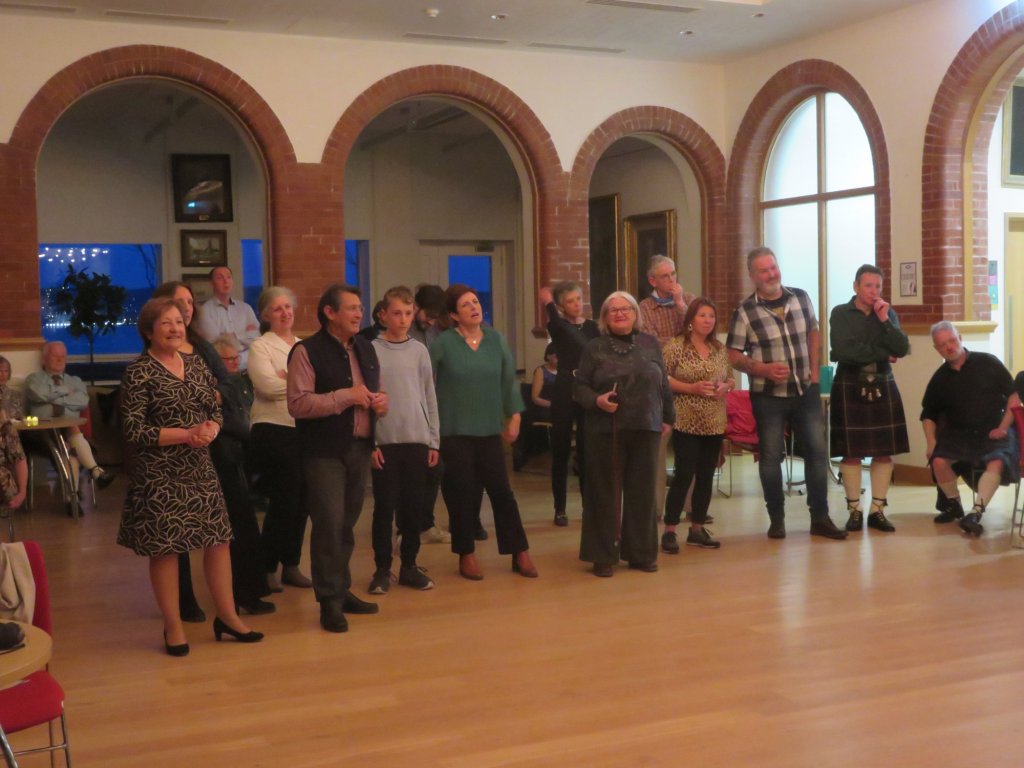
SATURDAY The visit started with a Ceilidh at the Civic Centre that evening. The Delegation fully participated in the dancing, and even playing the French equivalent of a bag pipe accompanied by group dancing similar to Scottish reels. All to a standing ovation.
SUNDAY began with a walk through the ‘Blossom trees’ in Helensburgh guided by Stewart Noble, Helensburgh’s Historian. The tour ending with a well -earned ice cream sundae at Dinos. The subsequent walk round the Hill House inside its iconic box literally took their breath away They were most impressed by the efforts being made to restore this world class domestic dwelling to its original condition.
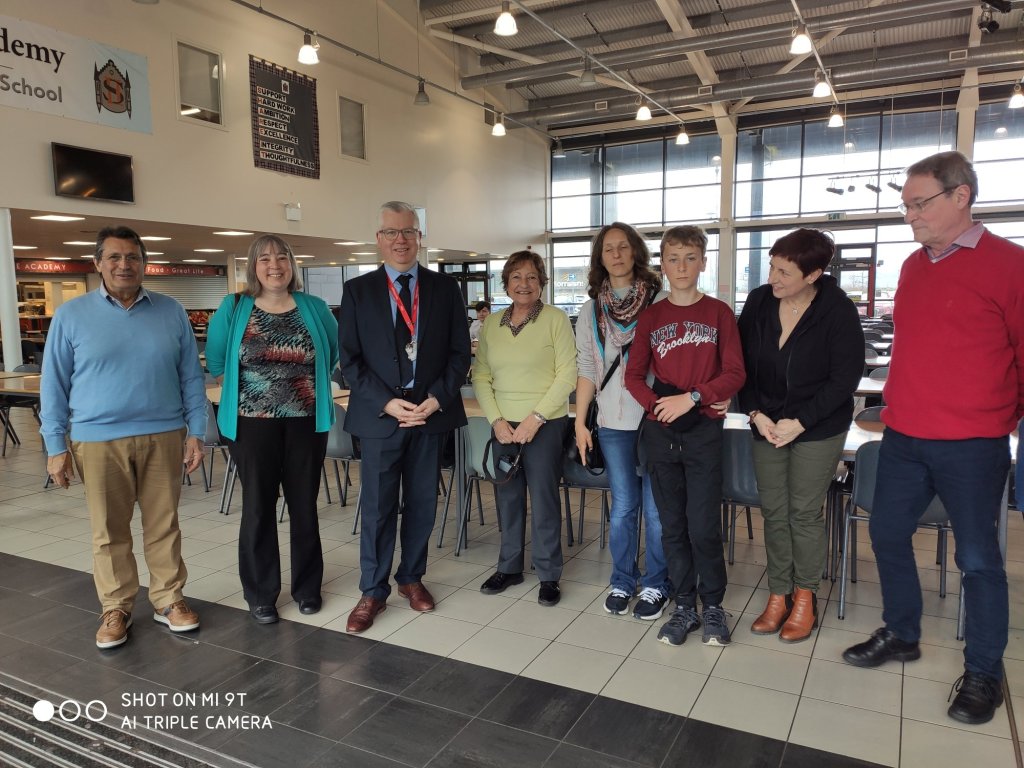
MONDAY: the Delegation paid a visit to Hermitage Academy, where they were royally treated to a Guard of Honour by the pupils from Classes 3 and 4, studying French. They were shown round the School by the Head of French, Mr Urquhart, who gave a running commentary in immaculate French. Later they had discussion with Mr Douglas Morgan the Head Teacher on topics such as school exchanges, and more.
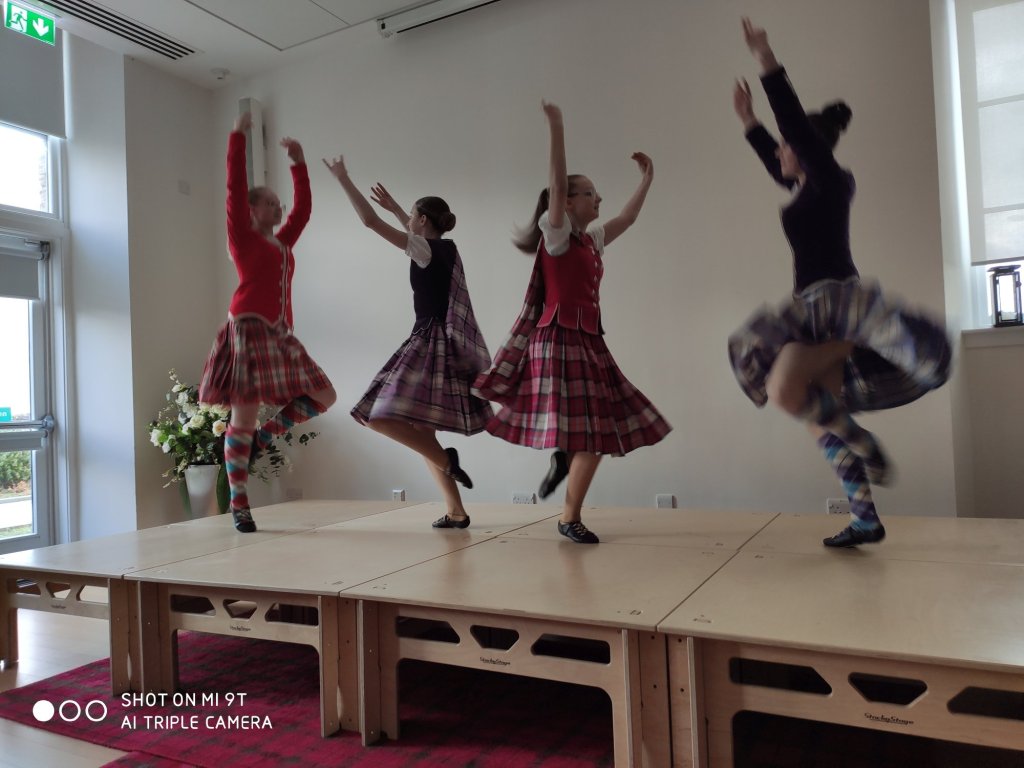
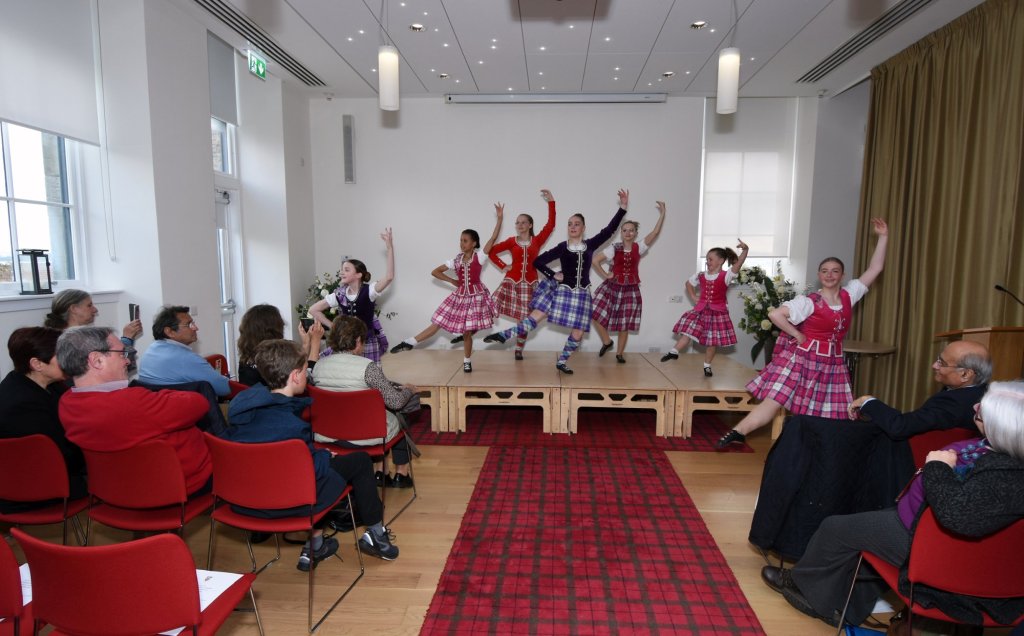
In the afternoon the Delegation were guests of honour at HCC’s Civic Reception in the striking Helensburgh & Lomond Civic Centre. They learned a lot about Helensburgh and we learned a lot about Le Taillan. But, the highlight of the Reception was the entrancing display of Highland Dancing from the Margaret Rose School of Dance. The young dancers literally took everyone’s breath away.
TUESDAY : the Delegation visited Lomond School where the Head of international links Mr Neil Mackay hosted the visit. He showed them round the School, the Boarding house and the Sports facilities. The visitors were impressed by all they saw, especially by the strikingly modern Sports Pavilion. .
WEDNESDAY. A tasting tour of the Clydeside Distillery : for some the highlight of the trip. This was followed by visits to the Transport and Kelvingrove Museums ending at Glasgow’s (in)famous Necropolis.
THURSDAY : a “Wash-Up” session with our French friends at Helensburgh’s impressive new Leisure Centre. In their feedback the Delegation rated every engagement as excellent. For them, their visit was an outstanding success with the hospitality and warmth they received throughout, second to none. Agreement reached on Next Steps centred on an invitation for a reciprocal visit by a Delegation from Helensburgh to Le Taillan to explore school exchanges, tourism opportunities and learning from the Bordeaux region on tackling Climate Change, Entrepreneurship, and more. To build on our new relationship planning would begin on a Helensburgh Arts, Music and Dance Festival in Le Taillan- Medoc sometime in 2024.
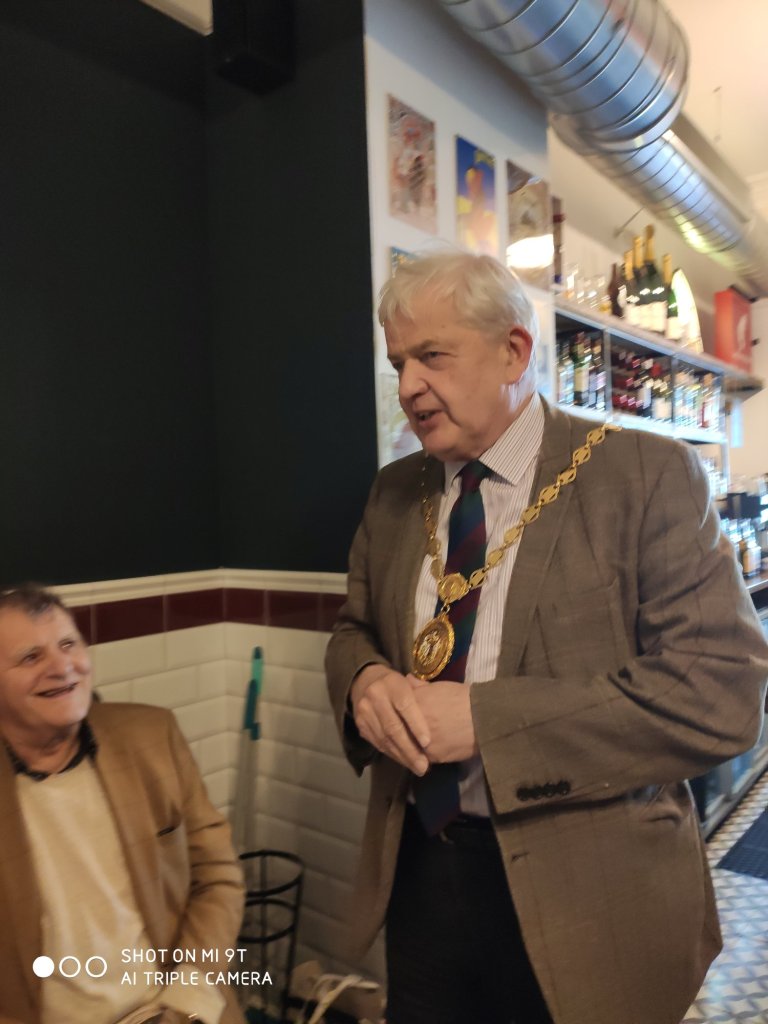
The day, and the delegation visit, ended with a Farewell Reception at Helensburgh’s own Parisian inspired wine bar – La Jupe. Hosted by Provost Maurice Corry there were toasts to the Auld Alliance with an exchange of gifts, entertainment, and canapes.
Tariq S Durrani
Nigel Millar
Helensburgh Community Councillors
April 2023

In January 2020, COSLA on behalf of the Scottish Government sent out a ‘Town Twinning Request Scotland’ listing a number of towns and cities in France and Germany.
The document was discussed at the 27 February 2020 HCC Meeting, and following a study of the listing of towns and cities, it was agreed that Le Taillan-Medoc , with a population of 10,000 offered a good match with Helensburgh. Other places represented much larger towns and cities, such as Potsdam, or small villages with a population of 5000 or less.
A key consideration was to discuss the prospects of twining with the Helensburgh Twinning Association that has promoted ties with Thoars in France for some 40 years. The President of Helensburgh District Twinning Association (Margaret McInnes) wrote a supporting letter on 2 May 2019, indicating their interest in promoting school ties, and even offering to take a delegation of the Margaret School of Dancing to Le Taillan, though indicating their focus at the time was to host a delegation from Thoars. It is worth noting that Helensburgh is not an exclusive twin town of Thoars.
Matters were in abeyance due COVID, nevertheless there were ZOOM exchanges between HCC officials and those from the Mayor of Le Taillan’s office, to learn more about the two towns and to explore the prospect offered by twinning. There were slide presentations in French and English at these ZOOM calls.
In the New Year 2021 the Mayor of Le Taillan wrote to HCC Convenor with an invitation to formalise the links.
Matters were then overtaken by rampant effects of COVID, though e-mail exchanges took place including exchange of greetings, till the recent visit by the le Taillan delegation in April 2023.
Tariq Durrani
31 January 2023.
In 2017, Helensburgh Community Council created a sub-committee, Vision for Helensburgh, to understand what the people of Helensburgh wanted their town to be like in the future. Since then, we’ve all experienced a significant shift in behaviours brought on by the pandemic.
The Vision for Helensburgh work is intended to be part of our response to any planning process with Argyll and Bute Council as part of any planning application for the waterfront development. However, given that the pandemic changed a lot of behaviours, we wanted to get an insight into what the community wanted to ensure that any response was as robust as possible.
Through a website, we invited people to answer one question:
What would you like to see built in the empty Helensburgh waterfront space?
There were four options:
People could then suggest other uses for the space or leave a comment.
We had 1,025 responses to the question. Here are the results:
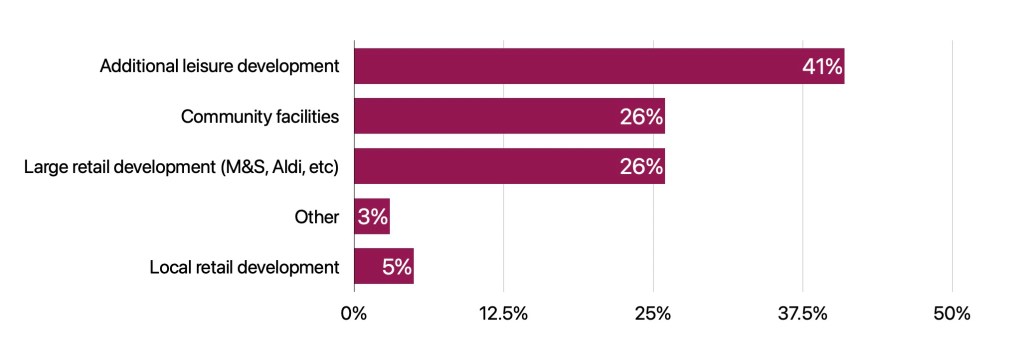
Looking more into the comments that people left, two themes arose.
You can download the presentation that was given to the Helensburgh Community Council for more information and comments from the questionnaire.
The HCC raised a number of faults within the town centre with Argyll & Bute Council recently which detract from the ambience of the town. The matter is now under urgent discussion with the officials.
Helensburgh Community Council and Helensburgh Garelochside Rotary Club are holding a community event to promote interest in local groups/organisations.
The free event will take place on Saturday 4th, March 10 am – 3 pm at Hermitage Academy.
Refreshments will be on sale organised by Grey Matters, selling tea/coffee and home baking.
Choirs and other music groups will be performing.
A wide variety of local clubs and organisations will have a table in the hall to promote their group activity.
People will really be surprised by the range of activities available for all ages and interests; sports, music, arts, choirs, hobby clubs,
uniformed organisations, pre-school, youth clubs, adult education, volunteering, gardening, and environmental.
For information, email Norman Muir at convener@helensburghcc.org
Entry is free for the community and we really do look forward to welcoming you and showing you what’s on your doorstep.

Helensburgh Community Council sent out a paper to Argyll & Bute Council outlining our position on the plans for the site of the old Helensburgh Swimming Baths. The community at large hasn’t yet been consulted by the council on what they would like to see on that site, and Helensburgh Community Council is adamant that the community’s voice is represented in any decisions moving forward.
You can view “The Waterfront Project Phase 2 – An Analysis” as a PDF download
I start this report by paying tribute to two community councillors whose recent untimely deaths came as a sudden shock and robbed the Community Council of their sound advice and public service experience.
John Tacchi contributed greatly to public life in Argyll & Bute over decades, firstly as an Argyll & Bute councillor and subsequently as a Helensburgh Community Councillor. He was completely involved in community life across a range of interests. He was chairman of the Horticultural Society and a particularly enthusiastic supporter of our rugby club.
Roger Ferdinand died in a swimming accident in Greece. He was a prominent figure in the retail sector of the town and a forthright member of the Chamber of Commerce. He extended his talents and abilities by becoming a Community Councillor for the past four years as our Secretary.
Both men shared a deep affection for the town and had a strong sense of community spirit to make the town a better place. Both embodied the ethos of the volunteer spirit which is a strong component of community life in the town. The actions of volunteers and volunteer groups are instrumental in keeping the town from the borders of decay. These cover a range of diverse activities from community groups and hubs, woodland groups, tree conservation, shrub beds maintenance, and beach cleans.
With the assistance of ZOOM, the HCC succeeded in functioning during the epidemic and its subsequent aftermath. We will continue with our ZOOM experiment since it allows members of the HCC and the community wider access to meetings. As a result, we were able to pretty well carry out our normal functions and also, we managed to pursue various initiatives on behalf of the community. Our series of webinars via ZOOM, orchestrated by Tariq Durrani and covering a wide field of topics continued to be a success and also engaged the community. We also finally brought to realisation an exhibition titled; ‘Visions for Helensburgh’ which had been delayed by the COVID epidemic.
Norman McNally and his team brought together a greatly appreciated display inclusive of most of the community organisations and groups within the town. There was widespread interest and appreciation from the community and the exhibition was deemed a success. The themes discussed included the environment, new development, health and well-being, the Navy and community assets. The community gave us clear indications of their views and expectations which formed the basis of the statistical analysis of the event. It presented a comprehensive picture of community priorities and expectations. The subject of a waterfront strategy attracted significant interest, ranging from Craigendoran through to Kidston Point. But the rejuvenation of the pier to become usable again and the ‘grey area’ of phase 2 of the waterfront development were the subjects of most debate at the exhibition.
The concept and proposal for the pier was very well received and there were no negative comments from the community. A small sub-committee has been formed involving our Vice Convener Peter Brown, the Visions coordinator Norman McNally and Maurice Corry, now Provost of Argyll & Bute, along with Tim Henderson a maritime civil engineer. The aim is to make the pier functional and commercially viable by extending it into deeper water to attract vessels the size of the Waverley and perhaps smaller cruise ships to earn revenue through berthing fees etc. Initial reaction has been positive and supportive. We now need to press on with technical issues and design concepts and a business case.
The HCC conducted a survey of the Memorial Garden in Hermitage Park which had fallen into neglect and was a poor advertisement for the town. Since the survey, tentative correction measures are taking shape to improve the situation but it will take a concerted effort from the community to restore the garden to its former status as a credit to the town. You can view the output of the survey here.
In conjunction with Plastic Free Helensburgh, the HCC recently conducted a survey of litter bins in the town principally concerning their inadequate function and appearance. Litter is a source of concern not only from a hygiene perspective but also it presents a lasting unfavourable impression of the town to visitors particularly tourists. On the waterfront it is a particularly bad problem and encourages seagulls to become more of a nuisance than they normally are. We hope to proceed with remedial action on the survey in conjunction with Argyll & Bute. You can view the results of the litter bin survey.
This area of the waterfront development takes its uninspiring name from the current prediction that the area enclosing the current carpark and the prospective demolition of the old swimming pool will be left with a cover of Grade 1 hard core. This is in the absence of any planning consideration for the space apart from the Council pursuing a retail option. The HCC has been seeking discussion with Argyll & Bute on the future of the space and the statistical results from the Visions for Helensburgh exhibition will allow us to reflect the firm views of the community. We are pursuing progress on this issue as a matter of urgency. This is in line with Scottish Government policy under the Community Empowerment Act of 2015 which allows communities greater oversight on decisions that matter to them.
The construction of the new swimming pool and leisure centre is nearing completion and handover. The contractors, Heron Bros, have attended to the construction phase extremely well and the project manager kept the community informed of progress. The site was maintained in a clean and tidy condition and the contractors kept very well to the schedule. The building occupies a commanding area of the waterfront and is an impressive structure which will be greatly appreciated by the community and outlying areas in the future.
Maintenance of the infrastructure of the town is a constant element of the work that the Community Council is engaged in. Small observations of decay begin to mount up to noticeable issues which can attract the observations of the community and visitors alike. It is therefore important that particular emphasis is placed on a maintenance programme which maintains the standards and functions of the town estate. Examples include, bent cycle stands hit by incompetent drivers; overflowing litter bins caused by inadequate volume and an unsuitable collection regime; the inappropriate procurement of street lighting equipment in which spare parts are difficult to source, leading to long lead times for repair; maintenance and cleanliness of seating benches in the square; CHORD road/pavement repair in the town centre; etc. Outside the town boundary, the cycle track over the hill to the Arden roundabout has potholes and overhanging vegetation presenting hazards to cyclists.
A maintenance schedule for the multi-million CHORD project lies dormant and leads to future concerns for the maintenance of the other multi-million investments in the town, the new Leisure Centre and the Lottery investment in Hermitage Park. It is appreciated that budgetary considerations are very much to the fore in this age of austerity. But it is difficult to reconcile this argument with the community’s knowledge that a great deal of council tax is collected from the town without appreciable benefit to the maintenance of local services.
The erratic communication and engagement between the Community Council and Argyll & Bute remains an issue. Anecdotally, this is explained by the volume of communication traffic that Argyll & Bute staff have to deal with. However, the issue is also expressed widely within the community and creates a reputational damage which lingers. The solution lies in a conscious effort to be more pro-active and engaged with the Community Council and treat it as a partner in common cause, rather than an adversary to be treated with suspicion. In this regard, we congratulate the recently elected Argyll & Bute Councillors for the Helensburgh and Lomond area and look forward to future engagement and working together.
Like other community councils we are sometimes inundated by consultations on a wide variety of subjects. Responses in good faith are barely acknowledged and any collective information that is gathered is not shared, nor is there any end solution of the consultation process made known. This leads to a less than motivated approach from the public and a diminution of the consultation aims and ambitions. The consultation process requires examination and improvement.
The Community Council faces a local election in October when all twenty councillor posts will be up for election or re-election. As the serving Convener, I should like to pay tribute to all my colleagues who have supported the community over a number of years and have represented the interests of the community during the stresses and strains of the pandemic. On a personal note, I have valued greatly the support given to me and the dedication of service they have given to the town. They represent a cross-section of the town, both male and female, serving a common aim of making the town a better place. They are of course volunteers and have a non-political affiliation.
We are constantly on the lookout for councillors who reflect all sectors of the community, from retailers to the young professionals living in the town, including Naval personnel. We also try to engage with the youth of the town to participate in community matters and a notable example of this was Rosie Sumsion a former Hermitage Academy pupil who gave us valuable service and insight on the youth scene in the town, while still at school.
With the results of the Visions exhibition we have a clear direction from the community input on planning for the future. The exhibition also indicated that the Navy was now very much part of the town and Helensburgh was categorised as a ‘Naval’ town by respondents to our exhibition survey.
We continue to be blessed with a thriving retail sector and our restaurant and café scene continues to gain prominence. Voluntary groups ranging from youngsters in Fun First, the Community Hub, to senior citizens in Grey Matters – Active Aging, do sterling work in support of the town. Our environmental interest lies in the two principal woodlands organisations, the Community Woodlands Group and Duchess Woods and also our Tree Trust who continue to nurture trees on the streets. We have also established liaison with Plastic Free Helensburgh and collaborated with them on several environmental projects. This is not to forget our volunteers who turn out for beach cleans and shrub bed maintenance in Colquhoun Square.
It is not too early to raise the focus on the centenary of the invention of TV by John Logie Baird which will take place in 2025/26. His invention was a major world achievement and is likely to attract considerable attention to the town. A small planning group has been formed to anticipate the event and includes the grandson of JLB, Iain Baird. If the expected influx of tourists and visitors is realised, it is vital for the reputation of the town that the maintenance of our town infrastructure is treated with increasing attention and priority from now until the centenary celebrations.
It has been a year bedevilled by post-epidemic and austerity issues which have to be faced and overcome. The Community Council remains optimistic that the town will survive and prosper but it needs positive attitudes and the willingness of everyone to participate. We shall do all we can to encourage a more pro-active relationship with Argyll & Bute Council to improve communication and engagement between us. In this way we can combine our abilities and energies to benefit the town and local areas and continue to make a positive contribution to local society.
Norman Muir
Convener
Helensburgh Community Council
June 2022
Below is a copy of a letter that was sent to Kirsty Flanagan, the Executive Director of Argyll & Bute Council on the 12th May, 2022
General
Over the July/August period in 2021 and in subsequent months, Plastic Free Helensburgh conducted a survey of the litter bins in the town. In the first instance, an inventory of the litter bin distribution and their usage was carried out by a young member of Plastic Free, Cameron Boswell. He conducted 9 surveys in the period. Plastic Free joined forces with the Community Council to bring the findings and subsequent follow-on details to the attention of Argyll & Bute Council.
Survey Details
The survey was conducted principally along the western esplanade of the town and the town centre. In these locations a total of 48 litter bins were checked. In general terms the serviceability of the litter bins was good. However, the serviceability of the permanently installed steel bins was highly questionable. Their principal failings were defective door catches, accumulation of dirt and debris underneath the bin and above all their design (an oval shape) which is incapable of handling any volume of waste. The logic that led to their procurement was clearly at fault.
Litter Bin Survey
The survey identified the concentration points of litter and thus the inadequacies of the system to deal with them. 27% of the total surveyed had a medium to high risk of litter being deposited on the ground. Of more concern, 35% of the total had a high to very high risk of litter overflow. This incidence of continual overflow was directly related to the close proximity of fast-food outlets and their associated packaging which contributed directly to the majority of litter overflow. In Helensburgh, the problem is exacerbated by weather conditions and the attention of seagulls. It is therefore a problem that is in urgent need of attention.
This is a problem that can be alleviated through a combination of more public confidence and an imperative in disposing of litter responsibly. It should be matched by the authorities to provide litter bins of suitable functionality and size to instil the necessary confidence in the community that the litter problem is treated seriously. This demands the procurement of litter bins that are of good design and commensurate size and importantly maintained and cleaned on a regular basis.
The majority of the litter bins surveyed are functional, however there are ‘choke points’ of litter concentration which have to be addressed. They are situated at Kidston Point, the John Logie Baird bust, the Bell Obelisk, and the Pierhead. A further issue is the continued use of dysfunctional steel bins which have no further useful purpose and should be replaced by more functional litter bins.
A photographic montage is attached at Annex A to show the extent of the litter situation in the various locations and the inadequacy of the litter bins to deal with the volume of litter on a regular basis.
It is quite clear that a lack of thought, imagination and a laissez-faire attitude continues to dominate the approach of Argyll & Bute to the litter issues in Helensburgh. This survey must represent the start of incremental improvement and involved engagement between the town and Argyll & Bute to address the litter problem. The current situation is a hindrance to litter education of the general public and a considerable drawback in encouraging visitors and tourists to come and enjoy the facilities the town.
Replacement Steel Bins
There are unintended consequences in the permanent placement of designer bins which are not fully functional. The stainless steel bins were a nice idea not fully thought throw by those who commissioned their procurement. They are a bad design, suffer from mechanical defects and create their own zone of mess due to an inability to access underneath the bin for cleaning purposes. The weathering some bins suffer from, leads to the question whether they are stainless or not. As a matter of principle all future litter bins must be moveable.
Choke Points
The choke points that have been identified must be considered a priority for improvement.
Kidston Point
The current situation is 1 black plastic standard bin in playpark; 2 x pair of black plastic standard bins in carpark.
Recommendation – the present setting is replaced with 2 x pair of user-friendly large capacity bins.
John Logie Baird bust
The present situation is 2 x stainless steel bins; 1 black plastic standard bin. Both stainless steel bins are very non-functional. At the time of the survey, one was out of service and the other had a faulty door. They epitomize the bad design of this type of bin and their lack of durability and serviceability.
Recommendation. – removal of steel bins and replaced with suitable moveable bins.
Henry Bell Obelisk
The present situation is 2 x stainless steel bins, 1 black plastic standard bin. One steel bin is non-functional, the other has weather damage and much staining underneath.
Recommendation – removal of steel bins and replaced with suitable moveable bins.
Pierhead
The pierhead includes the top carpark, swimming pool area and public area/toilet area. The present situation has a black plastic bin halfway down the pier; a black plastic bin at the pay meter point, 2 x black plastic bins at the swimming pool 1 black plastic bin at EV charging point, 1 black plastic bin at site of phone boxes, 2 wheely bins in weather shelter near toilets, 1 stainless steel bin, 2 black plastic bins.
Recommendation – The area is in a state of flux at the moment with the construction works underway but much can be done to rationalize the current distribution layout of litter bins and cater for the continuing volume of litter that has to be dealt with. New functional bins are needed as a matter of urgency.
Summary
There is a growing emphasis on the environment and public awareness of litter seems on the increase. The recent pilot litter bin scheme introduced by the Friends of Loch Lomond and the Trossachs along the A82 seems to have been a great success and shows what can be achieved by providing suitable, functional bins and an attentive litter collection regime. This was a collaborative project between local community interest and local authority and is a pointer for the future improvement of the litter problem in Helensburgh.
There are two main issues arising from the survey which have to be addressed. They are the removal of specific non-functional steel bins to be replaced with suitable moveable bins. The immobility of bins creates a permanent mess underneath which cannot be accessed for cleaning purposes. The second issue is the solution to the various choke points of litter overflow which occur with regularity. These present a continual seagull nuisance and a bad image for the town.
It is also an observation that the cleanliness and maintenance of litter bins is a psychological imperative in educating members of the public to become more aware and conscious of using litter bins. A clean, functional and attractive appearance of a litter bin is fundamental to its effective use and that requires a maintenance and cleanliness regime by the local authority.
The improvement in litter management can be achieved by both the Argyll & Bute Council and the Helensburgh Community Council meeting on a regular basis to achieve mutual consensus on the resolution of litter problems in the town. It is recommended that this association is established as a matter of urgency.
The Hermitage Park Memorial and Garden is an A-listed feature registered with Historic Environment Scotland. The Memorial was recently refurbished as part of the National Lottery funding award to rejuvenate and improve Hermitage Park. The Memorial Garden surrounding the Memorial remains a work in progress. See early image of the Garden, Annex A.
This report details the present condition of the Garden and the remedial action that will be necessary to bring it back to an acceptable standard. Through no one’s fault, benign neglect over the years has resulted in the shrub beds being largely overgrown and the trees and hedges requiring significant attention.
Ballpark dimensions of the enclosure of the Memorial and Garden are 70×70 metres. The area falls into four quadrants, north, south, east, and west.
The walls are generally in good condition with the exception of the entire length of the west wall. It is covered in climbing shrubs which have to be removed to preserve the wall. The wall then requires extensive maintenance by re-pointing with lime mortar. The remainder of the walls will also require the removal of climbing shrubs for preservation purposes.
A feature of the original planting was the introduction of yew hedges and topiary. Over the years they have had a patchy existence and now need careful thought as to their future. A significant number have died and need replacement in kind or alternative planting. A diagrammatic layout of the yew hedges and topiary is at Annex B.
The beds universally need complete overhaul and refurbishment. Inappropriate or intrusive wild planting has left a situation where only very few of the shrubs, etc. are worth retaining and considerable replacement with new planting will be necessary. It will include soil overhaul and improvement with additional compost. It will also be necessary to remove overgrown trees and stumps.
A plant bed to the rear of the Memorial is in need of care and attention and requires a
planned layout of appropriate plants. A tree stump in the plant bed requires removal.
The boundary wall enclosing the Memorial Garden serves as an identifying marker on which to detail the present planting situation and recommended remedial solutions.
The north wall lies directly behind the Memorial and is in good condition. Three separate shrub beds run along the length and are in much need of refurbishment. The first bed from the northwest corner contains a mixture of yew hedges and shrubs. The bed is overgrown. The middle bed is dormant and unkempt and contains a tree stump. The third bed in the northeast corner contains trees, shrubs and a small section of yew hedge. The bed is also overgrown.
Recommendation
Retain trees and shrubs worth saving; clear out the remainder of vegetation; double-dig and refresh the soil of the beds.
The south wall encompasses the ceremonial entrance gates to the Memorial. There are shrub beds to the left and right of the gates. The current planting layout is a mix of yew hedge sections and quince bushes. The logic of the yew hedges is difficult to understand but the quince bush layout is quite attractive and should remain.
Recommendation
The yew hedge sections are inappropriate and should be removed. The quince shrub bushes should be retained and the beds given the standard treatment applied to all the other shrub beds in the Garden.
The wall is in good condition and has a built-in pedestrian gate in the middle effectively providing a separation of two shrub beds. The first bed from the northeast corner contains a mixture of trees and bushes all of which require maintenance and refurbishment and the bed is overgrown. The second or lower bed has all but vanished and is completely overgrown.
Recommendation
Maintain and preserve the trees and shrubs worth saving and clear the remainder. Re-instate the lower bed; refresh the soil; double-dig and action a planting plan.
The wall has a built-in pedestrian gate separating two shrub beds. The wall is in need of extensive remedial pointing of the stonework to preserve it. This will involve Historic Environment Scotland in accordance with the listed status of the Memorial Garden. The entire shrub bed layout along the wall requires significant work. It is almost completely overgrown and requires a major clearance, only retaining the shrubs worth saving. There is a proliferation of climbing plants on the wall that must be removed to avoid further damage to the wall.
Recommendation
Major clearance of plants and vegetation; The shrub beds will also require double-digging and soil refreshment similar to the other beds.
The suggested plant list proposed by Melissa Simpson is as follows; Aster Herbstschnee, Aster White Ladies, Bergenia Bressingham White, Geranium macrorrhizum White Ness, Geranium nodosum Silverwood, Geranium sanguineum Album, Hosta fortune aureomarginata, Hosta undulata (medivariegata), Hosta wide brim, Lysimachia Candela, Polygonatum xhybridum (multiflorum), Vinca minor Gertrude Jekyll, Bergenia Bressingham White 2L, Geranium sanguineum Album 2L, Hosta Fire and Ice 2L, Hosta sieboldiana elegans 2L, Polygonatum biflorum 2L.
Note
Minimum plant quantity – 12 tray
No limit for 2L stock
Shrub list is in Annex C
• Detailed identification of plants and shrubs that can be saved.
• Planning and agreement on a planting plan between Argyll & Bute Council and the Helensburgh Community.
• Masonry attention to the boundary wall.
• Definition of costs and funding the refurbishment.
• Allocation of work and working parties.
• Timescale of completion.
The previous park manager, Melissa Simpson, has given the Community Council her thoughts and observations on how a refurbishment could take place and that will be the basis for further discussion on the subject.
It is also important that Argyll & Bute Council and the Community including agencies such as the Horticultural Society achieve a consensus agreement on the outcome.
The end result of the Garden refurbishment should be based on a public display of survivable horticulture with a colourful and imaginative planting arrangement, requiring a manageable amount of maintenance.
It is therefore recommended that this report is accepted as a consultative document for the above actions to take place as soon as possible.

